Manufacturers, architects, and engineers often need to compare EPDs when selecting suppliers or choosing products with the lowest environmental impact for their projects. To make an informed decision, it is essential to focus on the key factors that reveal the most important details of their environmental performance. These factors will help ensure a fair and accurate comparison between EPDs.
Comparability requirements
According to ISO 14025 (section 6.7.2), for two EPDs to be comparable, they must belong to the same product category and meet identical or equivalent methodological requirements in LCA.
Compliance with these requirements is easier when both EPDs have been registered in the same program and follow the same product category standards. However, EPDs from different programmes can also be compared, although this requires further assessment to ensure equivalence.
In the case of construction products, the UNE-EN 15804:2012+A2:2020 standard (Section 5.3) establishes additional requirements, such as the need to cover the entire life cycle of the product in the context of construction.
In principle, the comparison of products on the basis of their EPDs is defined by the contribution they make to the environmental performance of the building. Therefore, the comparison of the environmental performance of building products using the information from EPDs should be based on the use of the product and its impacts on the building, and should take into account the full life cycle (all information modules).
NOTE 1
EPDs are not tools for comparing building products and services outside the building framework.
NOTE 2
For the assessment of the sustainability of buildings, it is necessary to make a comparison of the environmental aspects and impacts together with the social and economic aspects and impacts related to the building.
NOTE 3
Benchmarks are necessary for the interpretation of a comparison. This standard does not establish such reference values or benchmarks.
Comparisons are possible at a lower level than the building, for example for systems, components or assembled products (construction solutions), for one or more stages of the life cycle. In these cases, the principle that the basis for the evaluation comparison is the entire building should be maintained, by ensuring that:
- the same functional requirements defined by legislation or in the customer’s specifications are met; and
- the environmental performance and technical performance of the excluded systems, components or assembled products are the same; and
- the quantities of any excluded material are the same; and
- {A2►} processes, modules, or stages of the life cycle excluded are the same; and
- the influence of product systems on the operational aspects and impacts of construction works is taken into account;
- The basic fluxes relating to the inherent properties of the material, such as the biogenic carbon content, the carbonisation potential or the net calorific value of a material, are fully and consistently considered as described in this standard. {►A2}
The information provided for such a comparison should be transparent, to enable the buyer or user to understand the limitations of comparability. A justification of all excluded aspects must be included.
NOTE 4 The difference between two products may be negligible in the context of the building.
If an EPD does not cover all the relevant life cycle stages for comparison, or if the assumptions that form the basis of the scenario of a declared information module are not applicable in the building context, then studies are needed to determine the environmental aspects and impacts of the specific scenarios for the calculation of modules beyond cradle-to-door modules. These calculations are based on scenarios and conditions that are appropriate for the building as the subject of evaluation.
Factors to ensure the comparison of EPDs:
- Type of EPD. Compare the same type of EPD.
- Functional unit. Products must be compared based on the same functional unit and belong to the same product category rule.
- Scope of the EPD. The comparison of the environmental performance of construction products using EPD information should be based on the use of the product and its impacts on the building, and should take into account the full life cycle (all information modules)
- System limits. the quantities of any excluded material are the same; and excluded processes, modules or life cycle stages are the same; and the influence of product systems on the operational aspects and impacts of construction works is taken into account;
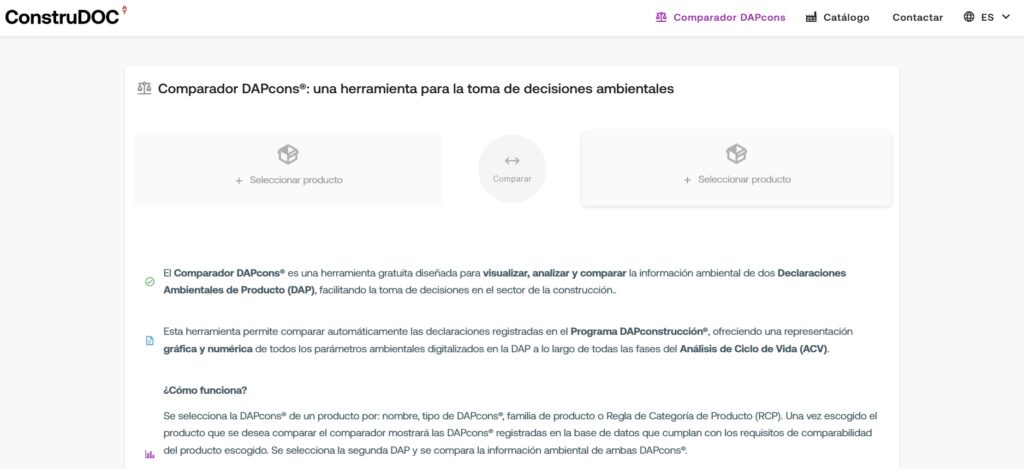
In order to promote informed environmental decision-making in the construction sector, Cateb has developed the DAPcons® Comparison TOOL, facilitating the selection of the most suitable product for each project based on its environmental impact.
The DAPcons® Comparison TOOL is a free tool designed to visualize, analyze and compare the environmental information of two Environmental Product Declarations (EPDs), facilitating decision-making in the construction sector.
This tool allows the declarations publised in the DAP Construcción® EPD Programme Operator to be automatically compared, offering a graphical and numerical representation of all the environmental parameters digitized in the EPD throughout all phases of the Life Cycle Assessment (LCA).